
 By Carl Weinschenk
Living expenses and everyday costs are among the most important political concerns for voters in California. Issues such as housing affordability, the cost of living, public safety, climate policy, and education shape how many Californians think about government — and whether they choose to vote at all.
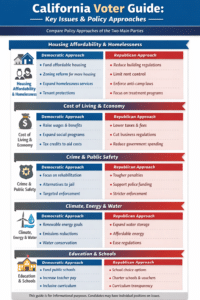
How these issues and others are handled by elected officials will impact livability in the state. The essay is followed by an infographic highlighting the same information and describing the Democratic and Republican positions on each.
This piece was written by ChatGPT and edited by CW.
Key issues facing California and its voters
California housing affordability and homelessness: Democrats generally emphasize increasing housing supply through state intervention. Democratic leaders support zoning reform to allow higher-density housing, expanded funding for affordable housing construction, tenant protections such as rent control, and significant public investment in homelessness services. Republicans argue these policies have failed to reduce homelessness and have driven up costs. They tend to oppose rent control, favor easing regulatory and environmental review requirements, and stress enforcement of laws against public encampments, alongside mental health and substance abuse treatment.
Regarding the cost of living and the economy: Democrats often focus on raising wages, strengthening labor protections, and expanding social safety nets. Policies such as higher minimum wages, paid family leave, and targeted tax credits are central to their approach. Republicans argue that taxes, regulations, and energy policies are the primary drivers of high costs. They advocate tax relief, reduced business regulation, and a more business-friendly climate to retain employers and encourage job growth.
On crime and public safety: Democrats tend to emphasize criminal justice reform, focusing on rehabilitation, alternatives to incarceration, and addressing the root causes of crime such as poverty and inequality. While many Democrats have moderated their stance in response to voter concerns, they often resist broad sentencing rollbacks. Republicans generally campaign on stricter enforcement, tougher penalties for repeat offenders, and increased support for law enforcement. They argue recent reforms have weakened deterrence and contributed to public perceptions of disorder.

Climate change, energy, and water policy: This is an area of stark divergence. Democrats strongly support aggressive climate action, including renewable energy mandates, electric vehicle adoption, and emissions reduction targets. They frame climate policy as both an environmental and economic opportunity. Republicans are more skeptical of mandates, warning that rapid transitions raise energy costs and threaten reliability. On water, Democrats prioritize conservation, ecosystem protection, and climate resilience, while Republicans emphasize storage infrastructure, water access for agriculture, and easing environmental restrictions.
Finally, on education and schools: Democrats focus on increasing funding for public education, teacher pay, and inclusive curricula. They generally oppose school vouchers and support strong teachers’ unions. Republicans emphasize parental choice, charter schools, and curriculum transparency. They argue competition improves outcomes and criticize what they see as politicization in classrooms.
In sum, California Democrats largely favor government-led solutions emphasizing equity, regulation, and public investment, while Republicans stress affordability, enforcement, market-based reforms, and individual choice. These contrasting approaches continue to shape electoral debates even within a state dominated by one party. Beneath it all, living expenses in California seem are the key.
*********
Below is an infographic, which shows where the two parties stand on those issues.

Here is more on voting in general and specific voting information for the states, D.C. and territories. It’s all vital as we begin to gear up for the midterm elections, which are in November.