The Wisconsin primary is on August 11. The parties must decide who will run to replace departing Governor Tony Evers and candidates for both the eight House seats and the state legislature.
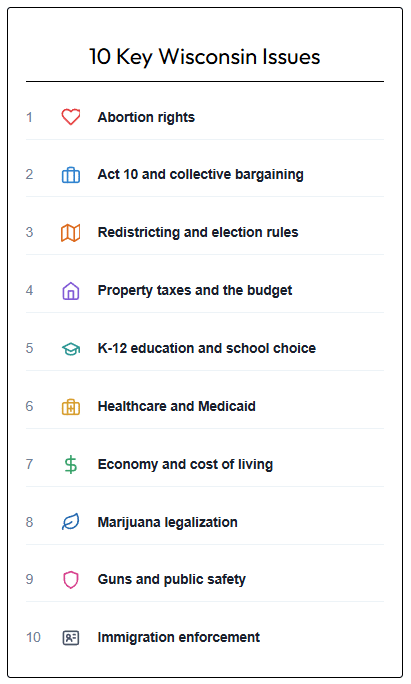
The Wisconsin primary clearly is an important one. Here are the top ten issues that voters will weigh in on:
1. Abortion Rights
Perhaps the key issue in the Wisconsin primary and subsequent election is abortion rights. The state’s 1849 law banning most abortions was more or less unenforceable for more than a year after the fall of Roe v. Wade. It then was struck down by a Dane County judge. The fight is still in the courts.
Democrats–including every major candidate for governor–want to codify abortion rights into state law. They also want to expand access to reproductive health care and appoint judges and justices who would uphold those protections.
Republicans, led by gubernatorial front-runner Tom Tiffany, tend to favor restrictions on abortion later in pregnancy. They argue the issue should be decided by the legislature rather than the courts. It’s important to note that the GOP field has avoided detailed proposals on enforcement due to the issue’s unpopularity with swing voters.
2. Act 10 and Collective Bargaining
In 2011, Act 10, stripped most public employees of collective bargaining rights. It helped launch Scott Walker’s national profile and suddenly is live again. A Dane County judge struck the law down in December. The case is expected to reach the state Supreme Court, which has a liberal majority.
Republicans counter that Act 10 saved local governments and school districts billions of dollars in benefit costs. They warn that reviving full bargaining rights would force property tax increases. Expect this fight to dominate both the gubernatorial race and legislative contests statewide.
Democrat are in lockstep: Each candidate for governor has pledged support for repeal. They argue Act 10 weakened schools and gutted teacher and public worker pay.
3. Redistricting and Election Rules
Wisconsin’s political maps and voting rules have been in litigation since Republicans drew heavily gerrymandered districts fifteen years ago. New legislative maps adopted in 2024 made led to more competition. Control of the state Supreme Court — now solidly liberal after Chris Taylor’s landslide spring win — will shape disputes about congressional maps, drop boxes and voter ID are resolved.
Democrats favor further changes to maps in an effort to reduce partisan bias. They also want to preserve ballot drop boxes and same-day registration.
Republicans favor strict voter ID enforcement, oppose further mid-decade redistricting and argue current rules protect election integrity.
4. Property Taxes and the State Budget
The large state budget surplus Tony Evers built up has largely been spent down. The Wisconsin primary is a sept in determining how tax policy and spending priorities.
Republicans have made property taxes a central attack line against Democrats. They warn that repealing Act 10 and expanding state spending commitments would force local tax hikes. They favor further income and property tax cuts.
Democrats say GOP-era tax cuts have disproportionately benefited high earners. They argue that new revenue should be shared among local governments, child care and schools.This approach would ease the property tax burden more effectively than blanket cuts.
Funding fights from the last budget cycle remain unresolved. Both sides agree teacher shortages and special-education costs are urgent, but disagree sharply on the mechanism for addressing them.
Democrats call for increased per-pupil state aid, higher special-education reimbursement rates and more oversight of the state’s voucher and charter school programs.
Republicans favor the continued expansion of school choice and open enrollment options. They are wary of new spending mandates on public districts. They argue that competition improves outcomes.
6. Healthcare and Medicaid
Republicans oppose expansion due to long-term cost concerns. They favor work requirements and program integrity measures.Democrats support full Medicaid expansion under the Affordable Care Act. The state has not adopted it despite Governor Evers support for it in every budget. The party also wants to protect coverage amid federal Medicaid changes.
7. Economy and Cost of Living
Democrats emphasize wages, child care costs and housing affordability. They generally support raising the state’s minimum wage above the federal floor. Republicans are campaigning heavily on inflation, housing costs and business regulation. They are pledging tax relief and deregulation to spur growth.
8. Marijuana Legalization
Republicans are divided. Legislative leadership is opposed. Some rural and libertarian-leaning people in the party have shown openness to medical marijuana expansion. Democrats support legalizing recreational marijuana, pointing to neighboring Illinois and Michigan as models and potential markets.
9. Guns and Public Safety
Democrats support universal background checks and red-flag laws.Republicans oppose new gun restrictions. They emphasize Second Amendment rights and favor tougher criminal sentencing and support for law enforcement.
10. Immigration Enforcement
Republicans back cooperation with federal immigration enforcement and oppose “sanctuary” policies.Democrats oppose local police involvement in federal immigration enforcement and support protections for immigrant families. They don’t push it as a top campaign message given its national volatility.
This list is evidence that the Wisconsin primary and the elections that follow will be crucial to the immediate and longer-term path taken by the state.
******
Wisconsin’s Key 2026 Races at a Glance
Governor
Governor Tony Evers is not seeking a third term. This creates the state’s first open race for the office since 2010.
On the Democratic side, state Rep. Francesca Hong, a self-described democratic socialist, has led recent polling over Milwaukee County Executive David Crowley, state Sen. Kelda Roys and former Department of Administration Secretary Joel Brennan. Former Lieutenant Governor Mandela Barnes suspended his campaign in late July.
Republican representative Tom Tiffany is the party’s clear front-runner. He is facing token opposition from Andrew Manske.
Attorney General
Democratic incumbent Josh Kaul is seeking a third term after deciding not to run for governor. Republicans are expected to field a challenger through the primary process, with the race shaping up as another marquee statewide contest.
Lieutenant Governor and Down-Ballot Races
Governor Evers’ retirement set off a chain reaction across every other constitutional office, so none of Wisconsin’s down-ballot statewide races have an incumbent running for the same seat this year.
Lieutenant Governor: The seat is open because current Lt. Gov. Sara Rodriguez left to run for governor. She eventually dropped out of that race. Secretary of State Sarah Godlewski passed on a run for governor and entered the Democratic primary for lieutenant governor, where she faces token opposition.. Former state Rep. Steve Johnson has filed for the general election.
On the Republican side, the primary competitors are Will Martin and Cyril Sablich. Wisconsin law mandates that whoever wins each party’s lieutenant governor primary runs on a joint ticket with that party’s gubernatorial nominee in November. It doesn’t matter if the two campaigned together.
Secretary of State: With Godlewski moving to the lieutenant governor race, this becomes Wisconsin’s first open secretary-of-state election since 1978. Milwaukee Alderwoman JoCasta Zamarripa is the best-known name in a four-way Democratic primary that also includes Collin McNamara and Lorenzo Southall.
Three Republicans — Brayden Myer, Nathan Pollnow, and Cindy Werner — are competing for their party’s nomination.Green Party candidate Pete Karas also will appear on the ballot. The office has few formal powers today. Regardless, the Democrats made it a flashpoint after Republicans signaled interest in expanding its role over elections if they win full control of state government.
State Treasurer: Republican John Leiber, the only GOP statewide officeholder in Wisconsin, is seeking a second term after his 2022 win.Two Democrats — Marathon County Supervisor Yee Leng Xiong and Black Earth village trustee Dylan Helmenstine — are competing in the primary for the right to challenge him. The office oversees the state’s unclaimed-property program and helps manage the $1.6 billion Common School Fund. The fund supports school libraries and technology.
U.S. House
The most competitive congressional seat is the 3rd District, where Republican incumbent Derrick Van Orden faces a rematch-heavy Democratic field that includes Rebecca Cooke and Emily Berge.
The 1st District, held by Republican Bryan Steil, and the 6th District, held by Republican Glenn Grothman also are being targeted by Democrats as potential pickups due to the favorable midterm environment.
State Legislature
Control of both the state Senate and Assembly is in play because new and less gerrymandered maps took effect in 2024. Democrats need a net gain of a small number of seats in each chamber to flip control for the first time since 2011. This could reshape everything from the state budget to Act 10.
Carl Weinschenk is a veteran technology and telecommunications journalist who has covered the industry for decades. He created Vote This Time to encourage sporadic and non-voters to participate in the 2026 midterm elections.
One thought on “10 Top Issues in the Wisconsin Primary”
[…] vs. Summer Takeaways from Abdul El-Sayed’s Win in the Michigan Democratic Senate Primary 10 Top Issues in the Wisconsin Primary News for the Week of August 3: Ranked Choice, The Importance of the Midterms, Why the Left is […]

 By Carl Weinschenk

[…] vs. Summer Takeaways from Abdul El-Sayed’s Win in the Michigan Democratic Senate Primary 10 Top Issues in the Wisconsin Primary News for the Week of August 3: Ranked Choice, The Importance of the Midterms, Why the Left is […]