 By Carl Weinschenk
After years of Democratic dysfunction and under-performance, the 2026 midterm elections was nothing but good news for the party and its voters. That means, of course, that there were plenty of unhappy people on the other side of the political fence.
Here are some notes on groups that didn’t like the results:
Those who believe the electorate is inelastic
Each party has their geographic and demographic strengths and weaknesses. The Democrats do well in the northeast and among those with college degrees and the Republicans in the south and among those with high school educations, for instance. This time around, however, the Republicans got clobbered just about everywhere. They lost in Mississippi, Georgia, Alaska, Ohio and Kansas – and barely hung on in Louisiana and Florida.
The bottom line is that the 2026 midterm election results proved that the majority of voters are not lemmings. Many voted for stricter immigration laws and the deportation of rapists and murderers. But they didn’t vote for government agents hunting down and deporting folks who are part of their communities and willing to do jobs the rest of us won’t. Millions of people who found this behavior reprehensible and terrifying are loyal Republicans.
The same bait-and-switch angered people with the inflation, tariffs, the war in Iran, attacks on the Supplemental Nutrition Assistance Program (SNAP) and ACA and other issues.
American oligarchs
It’s odd. From the rich guys going up in space to DOGE to the First Family’s blatantly unethical and unconstitutional financial dealings, the ultra rich go out of their way to showboat. Perhaps the ego necessary to amass and live with such wealth makes it impossible to do so on the down-low. The other 99.99% of us have seen who these people are during the past decade and are repulsed.
These folks will continue to be rich. Their lack of humility is a great target and making them pay their fair share will be a big deal in the upcoming presidential election cycle.
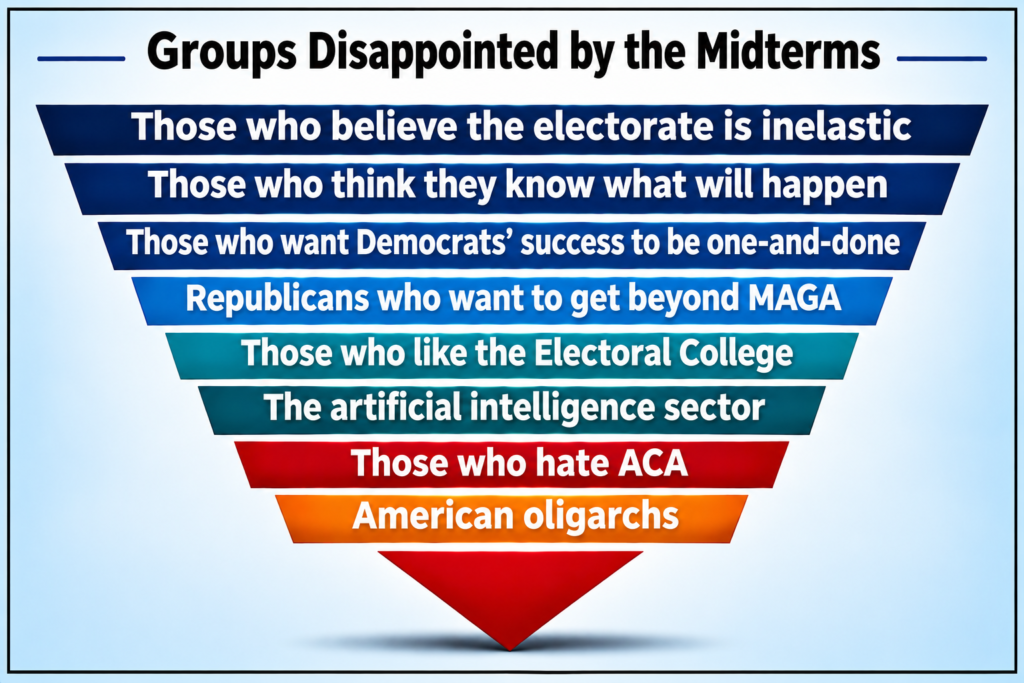
The artificial intelligence sector
The people developing AI are not the archetype pocket protector-wearing genius who takes breaks from his (usually) feverish research to provide breathless but incomprehensible updates. Instead, they are more or less a subset of the oligarchs or oligarch-adjacent folks described above. Moreover, the technology they are building threatens to hollow out the water and power resources communities in which they are built. There is a real (but apparently remote) chance that it can simply wipe us out.
There are two issues here: The real dangers and AI as a symbol of existential dread. AI will continue to be scary and a prime talking point of the newly empowered Democrats.
Republicans who want to get beyond MAGA
The MAGA wing of the Republican party has a Donald Trump problem. He’s old, ill-mannered, ill-tempered, erratic, racist, unpopular and picks terrible candidates. And he isn’t going anywhere. His core of supporters is diminished. But it still is big enough to enable him to dominate the GOP but too small to win elections on their own. There is no clear heir apparent and the candidates are a bunch of losers. The time may be ripe for the real conservatives to reassert themselves.
Those who like the Electoral College
 The existence of the electoral college led to the candidate finishing second in the popular vote becoming president in 2000 and 2016. The midterms brought us to the cusp of eliminating this outcome. The idea behind the Nation Popular Vote Compact, an initiative that has been kicking around for several years, is simple: States would pass laws awarding all their electoral votes to the candidate who wins the popular vote. It’s been a long slog, and enough states now are run by Democrats to put it over the top.
There is a catch, however: The decision to change the current system will generate countless lawsuits. The Supreme Court – unless it is reformed – seems unlikely to go along with a change that likely would favor Democrats.
Those Democrat’s success to be one-and-done
Gains were not just made at the House and Senate. US News & World Report sums up the flips from red to blue: Six governorships; four lieutenant governorships; five attorneys general; three secretaries of state and 12 state legislatures.
Victories as deep as the 2026 midterm election results have several possible ramifications. Democrats will be able to institute purer forms of their ideas (Medicare for All versus the Affordable Care Act, for instance) and will duly be rewarded if they succeed and punished if they fail. The deep gains also gives the party the chance to establish structures for long-term recruitment and talent generation.
Those who hate ACA
Most states have accepted an offer by the Federal government to subsidize an expansion of Medicaid to far more residents. There are ten holdout states. Acceptance in four of these – Texas, Wisconsin, Georgia and Kansas – is far more due to Democratic gains. In addition to helping folks in those states, the increased buy-in to the expansion will cement ACA even more deeply in our healthcare system.
Those who think they know what will happen
Pundits are debating whether the Democrats won the election or the Republicans lost it. Regardless, the results have set expectations high. Political victories can turn sour very quickly. The Democratic mantra leading up to Election Day was that the Democrats had to run through the tape. They won and they must keep running.
The 2026 midterm election results have given the Democrats a huge opportunity to do good. The drama of the next couple of years will be whether they do so or bend under the weight of their success and the structural tendency of our system to blunt change.
The first big test is the election of a majority leader. The incumbent us Chuck Schumer (D-NY) and the challenger Chris Van Hollen (D-MD). The result is important, of course. The way in which that selection is made – whether it’s a war or a negotiation – is just as important. It will say a lot about how Democrats will use their power.