
 By Carl Weinschenk
Get ready to hear a lot about Iowa politics. It’s not since 1968 – another big year in American politics – has the state had an open governor’s race and an open Senate seat. It’s the reality this year, with the retirements of Governor Kim Reynolds and Senator Joni Ernst. There are closely fought races at the district level. It’s highly likely the state will play a key role in who controls Washington.
Here are ten highest profile issues, with the focus on the top three:
Iowa Politics Main Focus is on Agriculture, Trade Policy and the Farm Economy
Iowa is all about farming. That makes trade policy and farm income deeply personal — and a more complicated story than it likely appears to an outsider.
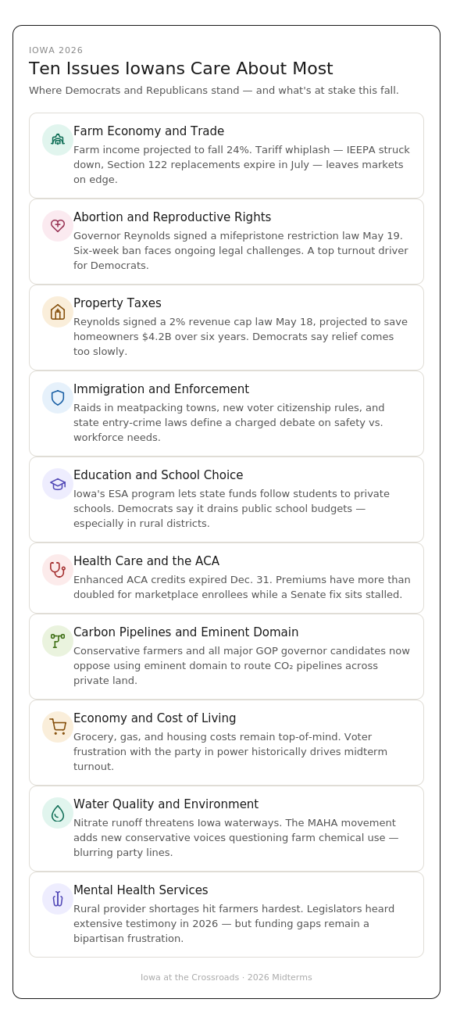
The Trump administration’s original IEEPA-based tariffs were struck down by the Supreme Court on February 20. The relief was short-lived. Within hours, the president imposed a replacement 10% tariff on all imports under Section 122 of the Trade Act of 1974 and quickly raised to the statutory maximum of 15%. Agricultural goods were carved out from those Section 122 tariffs. But steel and aluminum tariffs remain fully in place. This has increased costs for fertilizer, equipment and other things needed to run a farm. And the deeper damage from the earlier IEEPA tariffs — collapsed soybean exports to China, lost market share to Brazil and Argentina, and a projected 24% decline in Iowa farm income for 2026 — was not undone by a court ruling.
Adding political drama, the Section 122 tariffs are set to expire in late July unless Congress votes to extend them — forcing members of the House and Senate to cast a politically charged tariff vote less than four months before November’s election. Iowa Farm Bureau’s Iowa Secretary of Agriculture noted that trade is a major driver of profitability, with Iowa ranking second in the nation for agricultural exports at $13.7 billion in 2024.
The broader farm economic picture remains sobering. Iowa State University economists have described the one-year outlook as “troublesome.” Corn and soybean farmers are struggling to break even amid high input costs and weak commodity prices.
Mark Mueller, president of the Iowa Corn Growers Association, summed up the frustration bluntly in an article at KCRG-TV in February: “We used to be everybody’s first choice when they needed to buy grain or meat. We’re needlessly shooting ourselves in the foot when we pick fights with our trading partners.” A China soybean purchase deal announced by the Trump administration was welcomed by Iowa farm groups as “encouraging,” but farmers and industry leaders are calling above all for stability.
Democrats have hammered Republicans over the farm economy throughout 2025 and into 2026. They point to layoffs at John Deere, Kinze Manufacturing, Bridgestone and Tyson Foods. Republicans argue that the administration’s bilateral trade frameworks with more than 18 countries — including an $8 billion deal with Japan and improved EU access for U.S. agricultural products — represent real progress. They say that short-term pain will yield long-term gains. The issue remains the top concern for Iowa voters and the central battleground of the 2026 midterms.
Abortion and Reproductive Rights
Abortion remains one of the most galvanizing issues in Iowa politics. The Republican-controlled Legislature passed a six-week abortion ban in July, 2023 that has faced repeated legal challenges. In the 2026 session, Reynolds signed House File 2788 into law. It restricts access to abortion-inducing medications such as mifepristone by requiring in-person prescriptions and banning mail-order and telehealth dispensing. It is slated to take effect on July 1. Democrats and rural health advocates argue the law places a severe burden on Iowans in areas already experiencing maternal health care shortages. In these areas women may wait weeks for an appointment and be forced to travel significant distances to reach an OB-GYN.
All five Republican gubernatorial candidates have pledged to restrict abortion, with some calling for protection of “life at conception.” The party views these restrictions as a fulfillment of long-held conservative principles and a reflection of its base’s values.
Democrats see the issue as a motivator for turnout, particularly among suburban women and younger voters. They point to the medication restriction bill as an example of government overreach into personal medical decisions. Candidates at every level are making reproductive rights a centerpiece of their campaigns. They cite overperformance in special legislative elections in districts Trump won by double digits as evidence that reproductive rights are moving voters.
Property Taxes
Farmland values have soared and residential assessments have climbed sharply in Iowa politics. This makes property taxes a genuine kitchen-table issue, and one that crosses party lines. Indeed, it was the defining legislative fight of the 2026 session. Lawmakers reached a last-minute compromise after months of competing proposals from the House, Senate and governor’s office. Reynolds signed it into law on May 18. The measure caps local government revenue growth at 2% annually starting July 1, 2027. It is projected to save Iowa homeowners $4.2 billion over six years.
Republicans hailed the law as the session’s signature achievement. Reynolds framed it as the final piece of years of tax-cutting work. It followed income tax cuts that brought Iowa to a flat 3.8% rate.
Several Republican gubernatorial candidates called for the eventual elimination of property taxes altogether. Democrats were more skeptical. House Minority Leader Brian Meyer voted against the bill, arguing that the 2% revenue cap would arrive too slowly for families already struggling, and that essential services such as police and fire departments could be squeezed. Democrats proposed an alternative $1,000 immediate property tax rebate for all Iowans. They argued that targeted relief was needed now, not years down the road. The debate over who delivered real relief — and who protected local services — is already shaping campaign messaging.

Immigration and Border Enforcement
Iowa has seen significant immigration enforcement activity, and the issue remains highly charged. Reynolds signed legislation in 2024 creating a state-level crime for illegal entry, though courts blocked its enforcement. This year, the legislature advanced bills requiring state agencies to verify the immigration status of employees and license applicants. It requires voters to affirm their citizenship status at registration.
Republicans broadly support aggressive enforcement and have aligned with the Trump administration’s approach. Democrats argue that immigration raids in Iowa’s meatpacking communities have created fear, disrupted the workforce and separated families. They say that the state’s anti-immigration legislation goes beyond federal law in ways that are unconstitutional and harmful to the state’s economy.
Education and School Choice
Education has been a major Republican priority under Reynolds, who championed an Education Savings Account program that allows state funds to follow students to private schools. The party continues to push for expanded school choice, with all Republican gubernatorial candidates endorsing the concept.
Democrats argue that school choice diverts funding from already-underfunded public schools and exacerbates inequality between urban and rural districts. Teacher pay, curriculum standards and the role of Area Education Agencies — which provide special education services — are flashpoints in this debate.
Health Care and the ACA
Access to affordable health care is a persistent concern, particularly in rural Iowa where hospital closures have left many communities far from services. The enhanced ACA premium tax credits — which had helped more than 22 million Americans afford marketplace coverage — expired at the end of last year. Average out-of-pocket premiums [ link] (checkhave more than doubled for marketplace enrollees as a result. The House passed a bipartisan three-year extension on January 8, but the bill has stalled in the Senate. There is no resolution in sight.
Democrats argue that Republicans chose tax cuts for the wealthy over health coverage for working families. Republicans counter that a “clean” extension without reforms rewards fraud and waste. They favor redirecting subsidy funds into health savings accounts.
The issue has an Iowa-specific dimension: Rep. Zach Nunn, one of the most vulnerable House Republicans in the state, was one of only 17 Republicans who crossed party lines to vote for the House extension. His decision reflects the political pressure he faces in his competitive Des Moines-area district. Democrats also oppose Medicaid cuts that they say would harm low-income Iowans.
Carbon Capture Pipelines and Eminent Domain
Few issues have divided Iowa Republicans more sharply than carbon capture pipelines, which would transport carbon dioxide from ethanol plants across the state for underground storage. Opponents, including many conservative farmers, object to the use of eminent domain to route pipelines across private land without landowners’ consent. Reynolds vetoed a bill restricting pipeline eminent domain in 2025. All major Republican gubernatorial candidates now oppose eminent domain for pipelines. This is seen as a striking break with the outgoing governor and the carbon capture industry.
Democrats have largely sided with landowners on eminent domain grounds. It’s an issue that doesn’t fit neatly into the usual pattern of Iowa politics. For instance, environmental groups are divided over whether carbon capture is a net positive from the environmental perspective.
Economy, Inflation, and Cost of Living
Everyday economic concerns — grocery prices, gas, housing costs — continue to rank among the top issues for Iowa voters. University of Iowa political scientist and associate professor Timothy Hagle noted in a January story at KWQC-TV that cost-of-living concerns are always central in midterm elections and voter frustration with the party in power drives turnout. Democrats argue that Trump’s economic policies, particularly tariffs, have made inflation worse. Republicans contend that bold action on trade and taxes will produce long-term growth and stability.
Water Quality and the Environment
Iowa’s rivers and lakes have long struggled with nitrate runoff from farm fields. Water quality remains a background issue that periodically flares into public debate. Republicans have generally resisted mandatory regulation of farm practices, preferring voluntary conservation programs. Democrats and environmental groups say voluntary measures have failed and that Iowa needs enforceable rules and regulations to protect drinking water. The state’s Make America Healthy Again (MAHA) movement, which Reynolds has embraced, adds a new dimension: some rural conservatives are now raising concerns about agricultural chemical use and its health effects. This blurs traditional partisan lines.
Mental Health Services
Iowa traditionally struggles with access to mental health care, particularly in rural areas where providers are scarce. Lawmakers in the 2026 session heard extensive testimony about gaps in services. Republicans have supported some expansion of mental health funding while emphasizing local control and private-sector solutions. Democrats advocate more robust state investment and have criticized funding cuts that they maintain have worsened the crisis. The issue has particular resonance given the significant mental health challenges being experienced by farmers navigating tough economic times.
Iowa Politics: Key Races to Watch in the 2026 Midterms
U.S. Senate (Open Seat)
The race to succeed Senator Joni Ernst is considered the most competitive open Senate seat in the country. On the Republican side, Representative Ashley Hinson is the frontrunner, having launched her campaign hours after Ernst’s retirement announcement. She had secured the retiring governor’s endorsement. Former state senator Jim Carlin is also in the Republican primary. Democrats vying for the seat are state Senator Zach Wahls and state Representative Josh Turek. The seat is rated competitive, and national money is already flowing in from both parties. The primary is June 2.
Governor (Open Seat)
For the first time since 1968, Iowa will elect a new governor without an incumbent on the ballot. The Republican field includes Congressman Randy Feenstra (the fundraising frontrunner and Trump-aligned candidate), state Rep. Eddie Andrews, businessman Zach Lahn, Brad Sherman, and Adam Steen. Democrats have nominated state Auditor Rob Sand, widely seen as the party’s strongest candidate. Trump won 56% of the vote in 2024, making this an uphill race for Sand, but Democrats hope that a favorable national environment — which features concerns about tariffs, farm income and reproductive rights — gives them an opening.
1st Congressional District
This southeastern Iowa district, which includes Davenport and Iowa City, is the most competitive of Iowa’s four congressional seats. Republican Rep. Mariannette Miller-Meeks defeated Democrat Christina Bohannan by just 799 votes in 2024. Bohannan has signaled she may run again. The DCCC has already launched ads in the district, which appears on multiple national “most vulnerable” lists. Democrats believe that Trump’s tariff policies and health care cuts give them a compelling argument in a district with a significant college-town vote.
3rd Congressional District
The Des Moines-centered 3rd District, held by Republican Rep. Zach Nunn, is also rated competitive based on its voter registration balance. Former House Minority Leader Jennifer Konfrst is among the Democrats considering a run. National Republican and Democratic campaign committees have both already invested in the district, signaling that it will have a very high profile in November.
Sources: Iowa Capital Dispatch; KWQC-TV; Roll Call; The Gazette (Cedar Rapids); CBS2 Iowa; Iowa PBS / Iowa Press; CNN Politics; SCOTUSblog; Tax Foundation; Iowa Farm Bureau; Radio Iowa; Ballotpedia; Yahoo News and Iowa Public Radio.
Claude.ai researched and wrote the first version of this article. CW edited and rewrote.
[…] Paying More So Billionaires Pay Less Video: James Carville and Al Hunt on the Texas Primary Iowa Politics: The Top 10 Issues Shaping the 2026 Midterms Why Your Vote in the Midterms Matters Excuses for Not Voting (and Why They Don’t Hold […]