 By CW
By CWNot voting (or voting sporadically) is a choice. Though voters look down at those who abstain, it is their right. It’s akin to the decision to not practice religion. A vast majority of folks are available if approached in the right way. Make no mistake: Attracting nonvoters is a very big deal.
The events of the past year will change the equation for a lot of sporadic or nonvoters. Too much has happened for all but the most dedicated nonvoter to not cast a ballot. Next year’s midterms are an all-hands-on-deck, break-the-glass elections. The attracting nonvoters and sporadic voters most effectively will have a great advantage.
There is a lot of room to grow
Voter turnout was in the mid-60 percent-range in the 2024 (64%) and 2020 (66%) presidential elections, according to the University of Florida’s Election Lab. The midterms elections draw less participation. The percentage was 49% in 2018 and 46% four years later, according to Pew Research.
Those percentages certainly show a significant lack of civic engagement. From a pragmatic perspective, however, they are pure gold. In an era of high partisanship and habitually close elections the side that excels at attracting nonvoters has a big advantage. Even a small percentage of them could be decisive.
President Trump is on pace to have an approval rating in the twenties 11 months from now suggests that a lot of the folks coming off the sidelines will be doing so to play on the Democratic or Independent teams.
It’s fair to say, however, that attracting sporadic voters is tricky. Websites and social media appeal are the modern tools of voter outreach. Finding people online only extends to people who have demonstrated an affinity for a topic. An individual with a history of visiting sites related to major league baseball teams will be addressed (indeed, bombarded) by baseball-related offers. Same for cooking, luxury cars, travel destinations and so forth.
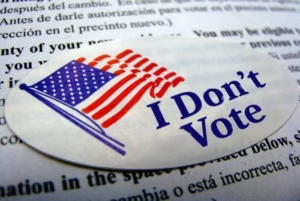
But nonvoters are a group that has not shown an interest in something. This is an invisible demographic. Some guesses can be made (such as assuming a reasonable chunk of people at employment sites are dissatisfied with the economy) but the direct connection is fuzzy and imprecise.
Thus, reaching those folks has to take what could best be called an old school approach with a focus on trying to reach out and win the battle, voter by voter.
Here are some thoughts and ideas on how to attract nonvoters. The first is online. The others are old school, face to face conversations.
Topical websites: I know I just wrote that the best approach to attracting nonvoters isn’t online. An exception is sites hyperlocal sites that focus on specific issues, not voting per se. Think broadband in Pennsylvania. Healthcare in Arizona. Education in Ohio. Honesty in government in Virginia. In these and myriad other scenarios, the site would point out that which party holds elected office matters a lot.
Here are some tips When encouraging a person who says they did not cast a ballot.
Don’t talk down to people who didn’t vote. It was obvious to many millions of people that electing Donald Trump would be a disaster. Those who didn’t think it through or simply were too lazy to vote probably are feeling a bit guilty. Especially if they, family and/or friends are negatively impacted by the decisions the administration is making. Keep in mind that people have a lot going on in their lives and may have neglected the responsibility to vote. Resist the temptation to blame them. Don’t be too strident. Be empathic.
Personalize the story. Talk about the horror of a citizen being dumped into an awful prison or thrown on a plane and sent to a country in which he or she never lived is more effective than a bunch of statistics.
Spend your time carefully. If the person still maintains that the two parties are the same and equally at fault it may be a good idea to move to walk away or just move on to another topic. People who still say this likely will remain nonvoters or even vote for Republicans.
Don’t be defensive about what the Democrats did. Own our faults. Say this is a new ballgame. Don’t waste time defending Joe Biden, Kamala Harris, Bill Clinton or anyone else. Don’t defend Democratic legislators who do something wrong.
Make the point that the level of theft and dishonesty in the Trump administration and the damage he is doing to us as a people is orders of magnitude greater than anything of which a Democratic president or lower-level elected official is accused.
Don’t shame people. People give a lot of reasons for not voting. Some of them are dumb. Don’t say, “That’s no excuse.” Accept them, show respect and suggest that it is important to work through whatever it is that kept them away until now. Be especially understanding if the person you are speaking with is trans, a person of color or a member of another targeted group. It’s entirely understandable if these people are reluctant to go to the polls. Tell them it’s okay and if necessary give them information about mail-in options.
Offer to provide them with information. On level, people who don’t like politics may truly not understand what a midterm election is and why it will impact the actions of the president. Explain patiently and without condescension. If they really seem intrigued, offer to provide information and, if appropriate, take them to register or to vote.
These ideas on attracting nonvoters are just the tip of the iceberg. Getting nonvoters or sporadic voters can be seen as a refreshing grassroots exercise in which technology plays a role but is not likely to make the difference. What will make the difference is talking to our relatives, coworkers and neighbors in a respectful and informed manner.